Biological valves used during surgical aortic valve replacement can deteriorate with time. When this happens, patients may face a choice between another operation and, in selected cases, a transcatheter valve placed inside the failing surgical valve. This approach is known as valve-in-valve TAVI. A 2025 clinical review describes it as an established option for selected failing surgical aortic bioprostheses, while stressing the importance of detailed planning because coronary obstruction, residual gradients, and patient-prosthesis mismatch can be important concerns.
Why do tissue valves fail?
Biological replacement valves are usually made from treated animal tissue.
Over the years, they can develop:
- Calcification
- Thickening
- Tearing
- Stiffening
- Narrowing
- Leakage
This is known broadly as bioprosthetic valve dysfunction.
Not every problem is caused by structural degeneration. Infection, thrombosis, or a mismatch between the valve and the patient’s required blood flow can also create problems.
The cause needs to be established before treatment is chosen.
What symptoms can occur?
Possible symptoms include:
- Increasing breathlessness
- Reduced walking ability
- Fatigue
- Dizziness
- Chest discomfort
- Swelling
- Fainting
- Recurrent heart failure
The symptoms resemble those of native aortic stenosis or regurgitation.
Patients with an older surgical valve should not assume that new breathlessness is simply a normal part of ageing.
How is a failing valve diagnosed?
Echocardiography is usually the starting point.
It can evaluate:
- Valve gradients
- Restricted leaflet movement
- Leakage
- Heart function
- Pulmonary pressure
CT imaging may be particularly important when valve-in-valve TAVI is being considered.
Doctors need to know exactly which surgical valve was implanted.
Old operation records and valve identification cards can therefore be extremely useful.
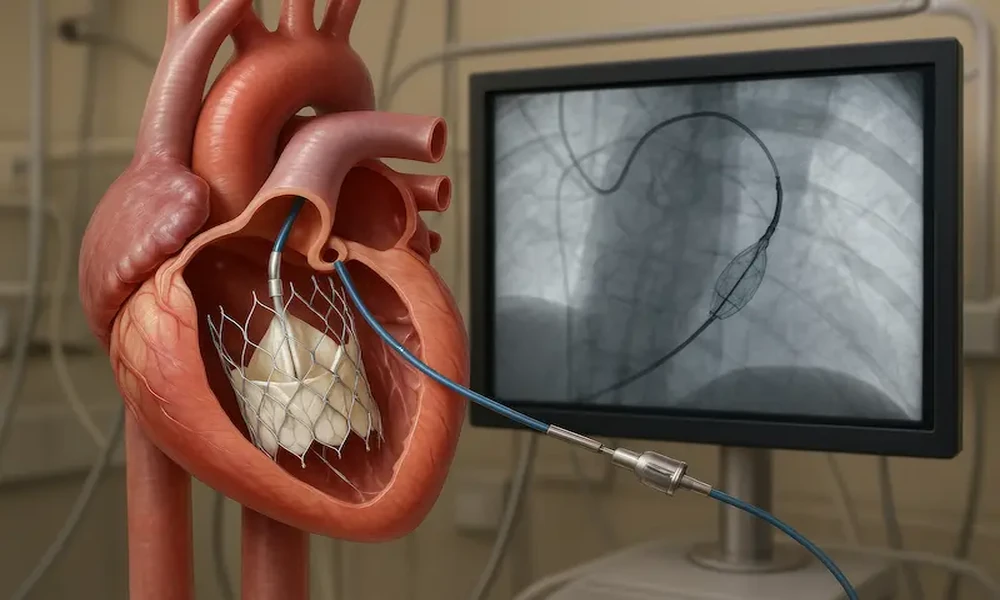
What happens during valve-in-valve TAVI?
Instead of removing the old surgical valve, a transcatheter valve is positioned inside it.
The frame of the old valve provides a structure into which the new valve can be placed.
This can avoid repeat sternotomy in appropriate patients.
However, the old valve’s internal dimensions limit the space available to the new valve.
Why valve size matters
A small previous surgical valve can create a challenge.
Placing another valve inside it can leave a relatively small opening for blood flow.
This may result in a higher residual gradient or patient-prosthesis mismatch.
A 2025 meta-analysis comparing valve-in-valve TAVI with redo surgery found favourable short-term outcomes for valve-in-valve treatment in several measures but also identified higher transprosthetic gradients and more severe patient-prosthesis mismatch.
Therefore, “less invasive” does not automatically mean “better for every patient.”
What is coronary obstruction?
The coronary arteries arise just above the aortic valve.
During valve-in-valve treatment, the old valve leaflets can be displaced.
In certain anatomical situations this may obstruct coronary blood flow.
Detailed CT planning is therefore essential.
Specialised techniques may sometimes be used when the risk is high, but they are not appropriate for everyone.
When might repeat surgery still be preferred?
Repeat surgical valve replacement may be appropriate when:
- Another heart operation is required
- The old valve is very small
- Infection is present
- Coronary anatomy is unfavourable
- Valve-in-valve haemodynamics would likely be poor
- The patient can safely undergo surgery
- Lifetime valve planning favours surgery
A Heart Team should compare the two strategies.
Who may benefit from valve-in-valve treatment?
It may be particularly attractive for selected patients whose surgical tissue valve has failed and whose risk from repeat open-heart surgery is increased.
Age alone should not determine the decision.
Frailty, kidney function, lung function, anatomy, previous operations, life expectancy, and patient preferences also matter.
What should patients ask?
Useful questions include:
- What type and size of surgical valve do I have?
- Why has the valve failed?
- Am I suitable for repeat surgery?
- Is my valve large enough for valve-in-valve treatment?
- What does CT show about my coronary arteries?
- What gradient is expected afterward?
- Could I need another procedure in the future?
- What are the main risks in my individual case?
Heart Valve Experts provides an educational resource explaining valve-in-valve TAVI and the assessment required when a previous surgical tissue valve has deteriorated.
Valve-in-valve TAVI can provide an important option for some patients, but it should follow careful anatomical and lifetime-treatment planning rather than being selected only because it avoids another sternotomy.